
EQ-25 · I²S microphone · Full kit
Compare quiet and speech samples
A round digital MEMS microphone module with pre-soldered headers for audio input projects.
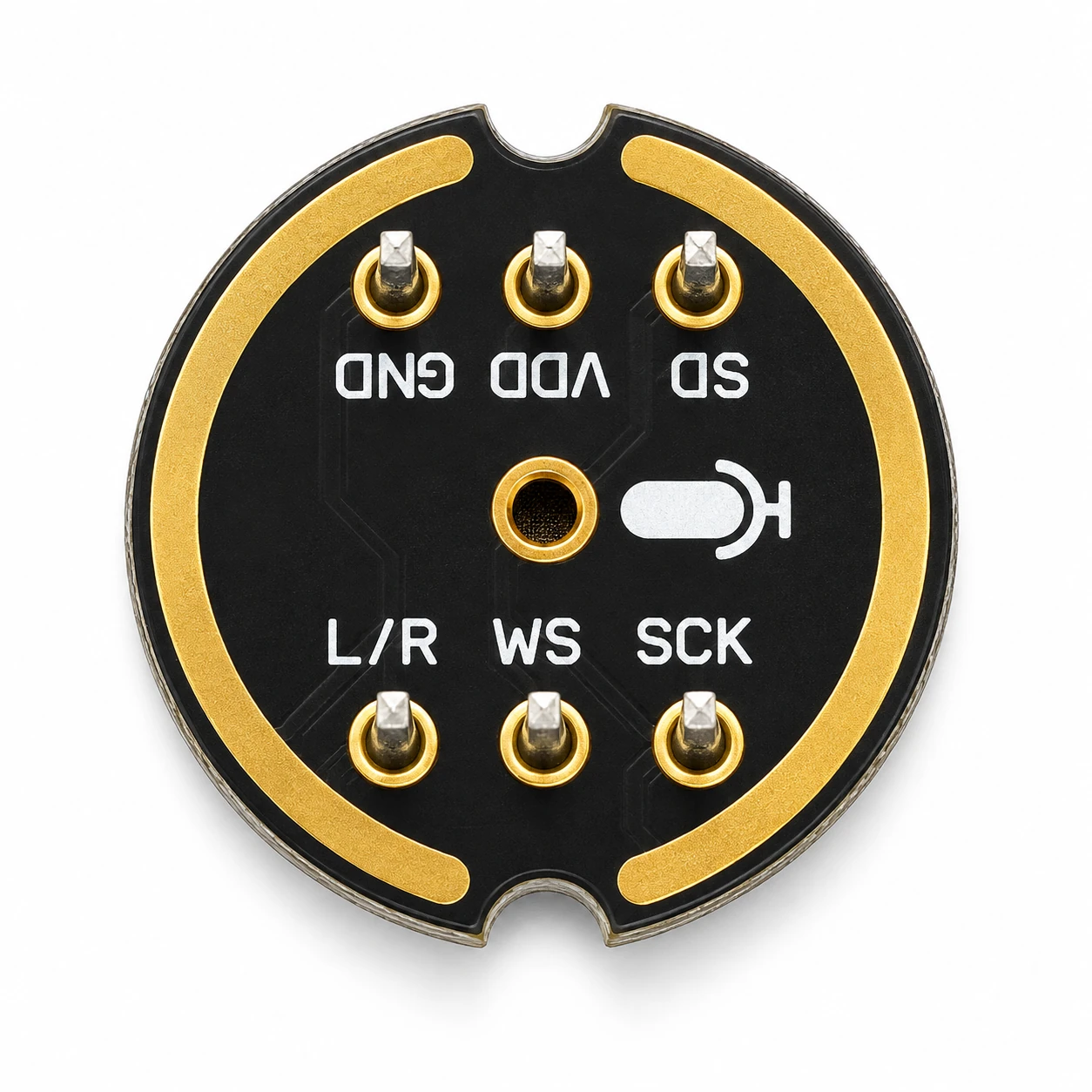
How to use it
You’ll need: ESP32-S3 with a MicroPython build that provides machine.I2S, INMP441-compatible module, jumper wires and USB data cable.
Connections
This example uses one part at a time on the MoloWorks ESP32-S3. If a course uses different GPIO pins, follow that course’s wiring and code together. Disconnect USB and any external power before changing wires.
| On the part | Connect to |
|---|---|
| Microphone VDD / VCC | ESP32 3V3 |
| Microphone GND and L/R | ESP32 GND; L/R low selects the left channel |
| Microphone SCK | ESP32 GPIO5 (bit clock out) |
| Microphone WS | ESP32 GPIO6 (word select out) |
| Microphone SD | ESP32 GPIO7 (audio data input) |
- Keep the acoustic port clear and power the module at 3.3 V. Wire L/R to ground for this left-channel test. The ESP32 supplies the two clocks; the microphone sends data back on SD.
- Run the receive example and compare the peak readings in a quiet room and while speaking nearby. The example reads 32-bit I²S slots as a starting configuration for compatible modules; that does not specify the microphone chip or its sample resolution.
- If readings remain at zero or barely change, check L/R, the clock pins, and the firmware’s I²S support. For a different channel selection use an appropriate receive format rather than swapping the data and clock wires.
MicroPython example
Run this on the board with your MicroPython editor. Set up the ESP32-S3 first if you don’t have a working connection.
from machine import I2S, Pin
from struct import unpack_from

mic = I2S(0, sck=Pin(5), ws=Pin(6), sd=Pin(7),
          mode=I2S.RX, bits=32, format=I2S.MONO,
          rate=16000, ibuf=8192)
buf = bytearray(4096)
try:
    for _ in range(60):
        size = mic.readinto(buf)
        peak = 0
        for i in range(0, size - 3, 4):
            peak = max(peak, abs(unpack_from("<i", buf, i)[0]))
        print(peak)
finally:
    mic.deinit()
What to look for: The raw peaks generally rise while you speak. The example prints levels only and does not record a file or calculate decibels.
AI prompt
Copy the prompt and replace any brackets with details from your kit. Check the suggested wiring against the labels on your parts before applying power.
Compare quiet and speech samples
My MoloWorks microphone is INMP441-compatible; the exact chip is unconfirmed. On a MicroPython ESP32-S3 I use 3.3 V, L/R low, SCK GPIO5, WS GPIO6, and microphone SD into GPIO7. Give me an I²S RX test for left-channel raw peaks using 32-bit slots, with no recording and no claim about chip resolution. Help me check clocks, channel selection and I²S support if I only see zeros.